
Adoration of the Magi (1680-1689) by Rybotychi School - Public Domain Orthodox Icon
Icon of the Adoration of the Magi by the Rybotychi school, made in the 1680s. It is held in the National Museum in Warsaw, Poland.
The ivory figures are mounted on a sheet of whalebone. This plaque is part of a series of Passion carvings that are now dispersed among Antwerp, Oslo, Paris, London, and New York. French, elephant ivory with traces of paint and gilding, 23.2 x 18.3 cm.
In his left hand the Christ Child holds a swallow. Swallows were thought to hibernate during winter in nests of mud. Their re-emergence in spring symbolized the Resurrection of Christ.
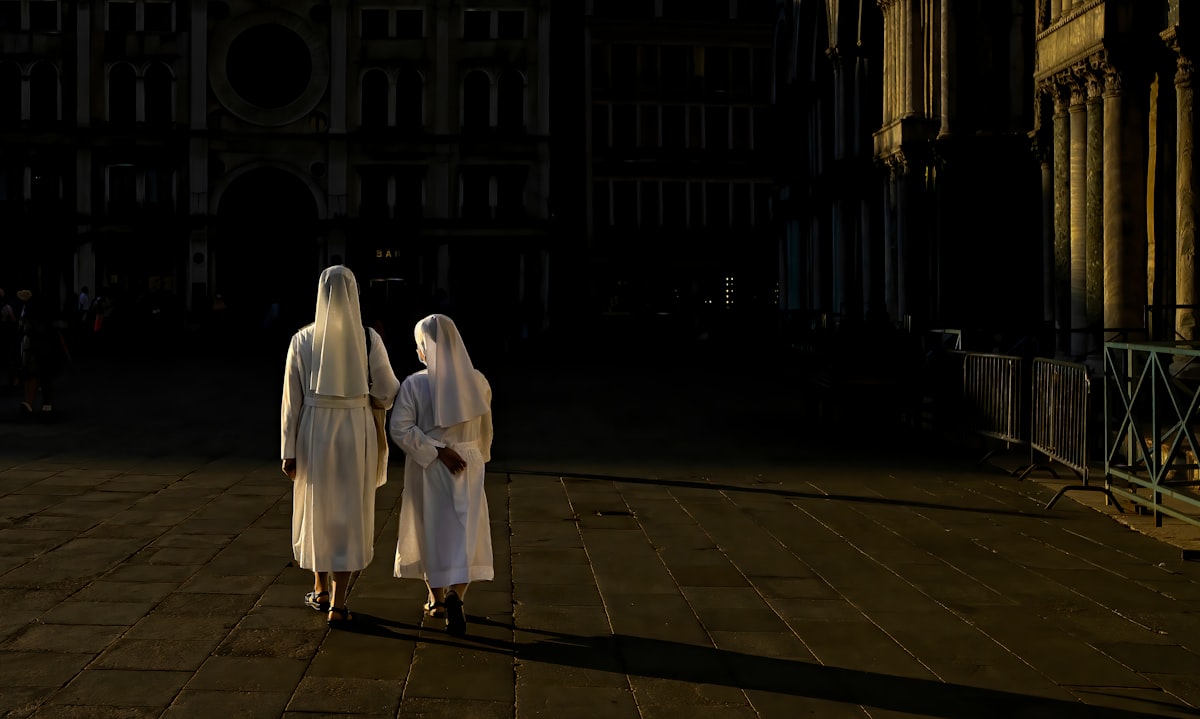
This is a list of my favorite 12 orders of Catholic nuns and sisters in no particular order. This list includes their history, and images of their habits. What is a Catholic Nun or Sister? In the Roman Catholic tradition, there are many religious institutes of nuns and sisters (the...
Learn the purpose of The Free Catholic Gallery with this short blog.
Top selling books published by Shalone Cason.
Illustration of five Benedictine saints (Saint Benedict, Saint Scholastica, Saint Justina, Saint Maurus, and Saint Placidus) by Anna Jameson, from the Wellcome Collection.
Jacques Callot’s etching series The Small Passion exemplifies the artist’s penchant for intimate detail. These prints highlight the ways he depicted space throughout a complete narrative. He framed each stage of the Passion of Christ with a different type of architectural or natural element. The por
This altarpiece is said to have come from the convent of the Ursulines in Amiens, France. North French or South Netherlandish, polychromed and gilded limestone, 48.3 x 48.3 cm.
The Assumption of the Virgin, celebrated on August 15, is an especially important holiday in Siena. Niccolò di ser Sozzo, one of the city's renowned fourteenth-century illuminators, painted it on numerous occasions. Tempera, ink, and gold on parchment, 57.5 x 40.4 cm.
This medallion is one of a group of twelve that once surrounded an icon of the archangel Gabriel. The medallions may have been sent as a gift from the Byzantine court to the neighboring Christian state of Georgia. Byzantine gold, silver, and cloisonné enamel, diameter 8.3 cm.
Icon of the Adoration of the Magi by the Rybotychi school, made in the 1680s. It is held in the National Museum in Warsaw, Poland.
This medallion is one of a group of twelve that once surrounded an icon of the archangel Gabriel. The medallions may have been sent as a gift from the Byzantine court to the neighboring Christian state of Georgia. Byzantine gold, silver, and cloisonné enamel, diameter 8.3 cm.
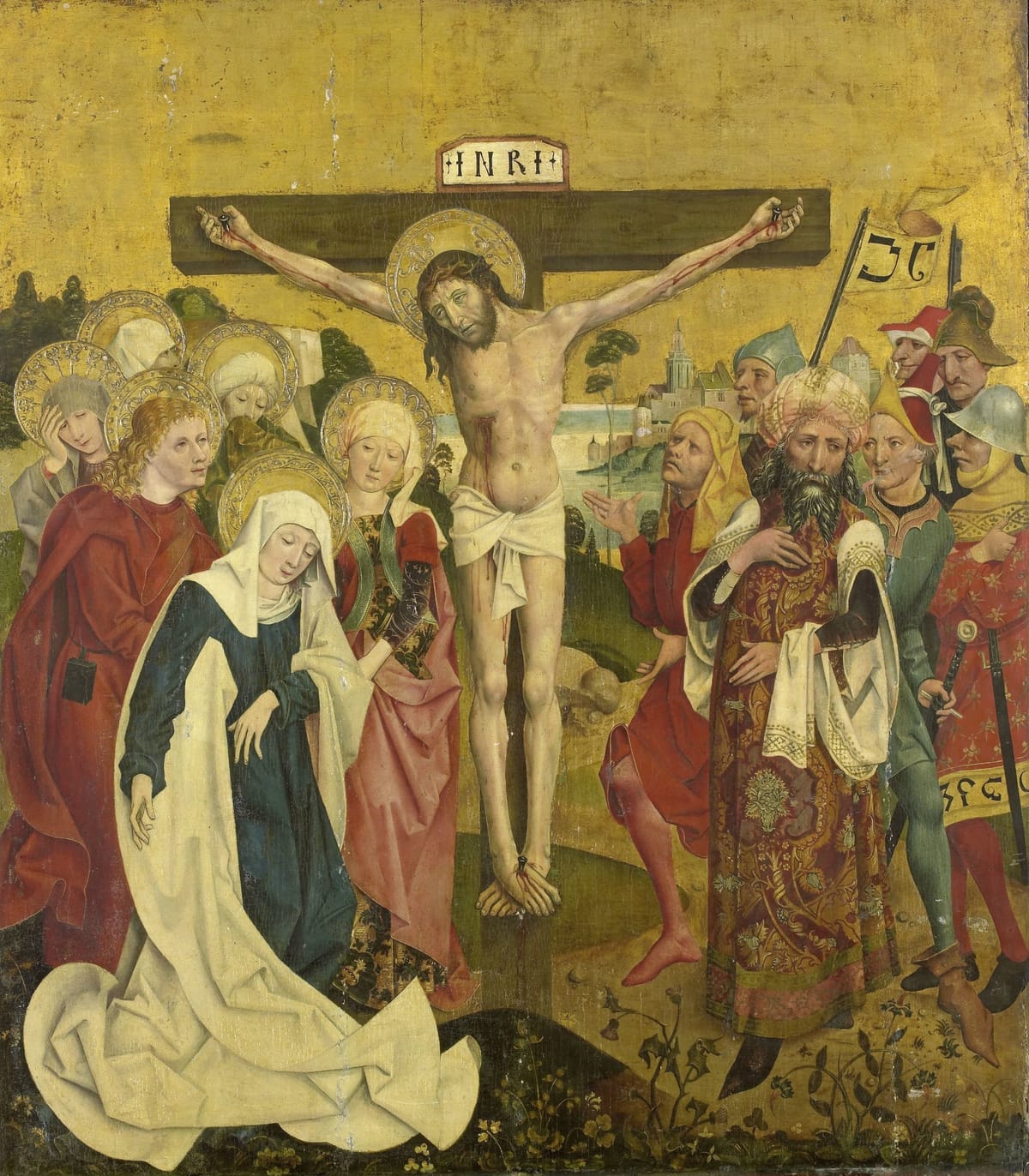
Tempera on wood panel with a gold ground showing the Crucifixion of Christ. The panel measures 43.5 x 20 cm.
South Netherlandish stained glass panel showing a holy man with two suppliants. Pot metal and white glass with vitreous paint and silver stain, 76.8 x 57.2 cm.
The ivory figures are mounted on a sheet of whalebone. This plaque is part of a series of Passion carvings that are now dispersed among Antwerp, Oslo, Paris, London, and New York. French, elephant ivory with traces of paint and gilding, 23.2 x 18.3 cm.
One of a set of prints intended to fit together. Engraving, sheet 74 x 50.8 cm.
An Italian illuminated choir-book leaf showing the Trinity within a decorated initial T. Tempera, ink, and gold on parchment, leaf 56.8 x 39.5 cm, with the initial letter about 14.3 x 14.2 cm.
Limestone statue of the Virgin and Child with traces of polychromy, French or German. The sculpture is 51 cm high.
Limestone statue of the Virgin and Child with traces of polychromy, made in France by the Atelier of the Juliots. The sculpture is 39.2 cm high.
This medallion is one of a group of twelve that once surrounded an icon of the archangel Gabriel. The medallions may have been sent as a gift from the Byzantine court to the neighboring Christian state of Georgia. Byzantine gold, silver, and cloisonné enamel, diameter 8.3 cm.
The typical image of Saint Paul—with a long face, receding hairline, and pointed beard—was established during the first centuries of the Christian church. Here Paul holds a book, an appropriate symbol for the author of many of the texts of the New Testament.
Icon of the Adoration of the Magi from the Sudova Vyshnia school, made in the second half of the 17th century. It is kept in the Historical Museum in Sanok, Poland.
Traditional locations within manuscript psalters were designated by decorated initials or, as is the case here, full-page miniatures. These locations marked the major divisions of the psalms as used in the daily office. Tempera and burnished gold on vellum, sheet 12.5 x 8.4 cm.
This leaf survives from what must have been an extraordinarily rich book of hours. Internal evidence within the original calendar and texts indicates that Metz was the probable place of production. Ink, tempera, silver, and gold on vellum, 15.9 x 11.6 cm.
In the late 1400s and early 1500s Rouen was an established and important center of book production. This artist, named after a manuscript now in Geneva, was Rouen's principal illuminator during the second half of the 1400s. Ink, tempera, and gold on vellum, folio 99 verso, codex 19.5 x 13.1 cm.
A decorated letter R cut from a choir book (antiphonary) showing the Resurrection of Christ. Tempera and gold on parchment by an Italian artist, sheet 19.8 x 17.9 cm.
This triptych icon was probably commissioned by a lay person for private prayer and meditation. It could be folded and shut when not in use. Painted wood panel within an enameled brass frame, Russia, about 6.5 x 6.2 cm unframed.
This spectacular example of goldsmith's work has been attributed to Giovannino de Grassi, an artist active in northern Italy.
Italian antiphonary leaf with Saint John the Evangelist and Saint John the Baptist in an historiated initial M, in tempera, ink and gold on parchment. The leaf measures about 56.7 x 39.6 cm.