Orthodox Cross (2009) by unknown
Orthodox Christian cross with the inscription Iesus Hristos is victor. Free DownloadThis image is in the public domain.orthodox-cross.jpg34 KBdownload-circle Please SUBSCRIBE or DONATE to help keep this site free!...
This angel carries symbols of the Passion—the events associated with Jesus Christ’s suffering and death. The pitcher, basin, and cloth represent those used by Pontius Pilate to wash his hands of responsibility for Christ’s crucifixion.The painting belongs to a series of twelve angels carrying symbols of...
This Gospel Lectionary from the eleventh century was written in clear Carolingian minuscule in Regensburg, Germany. Its original treasure binding is very fragile because the spine is made from delicate Byzantine or Islamic silk, so it is not possible to photograph the whole manuscript. Only the cover has been photographed,...
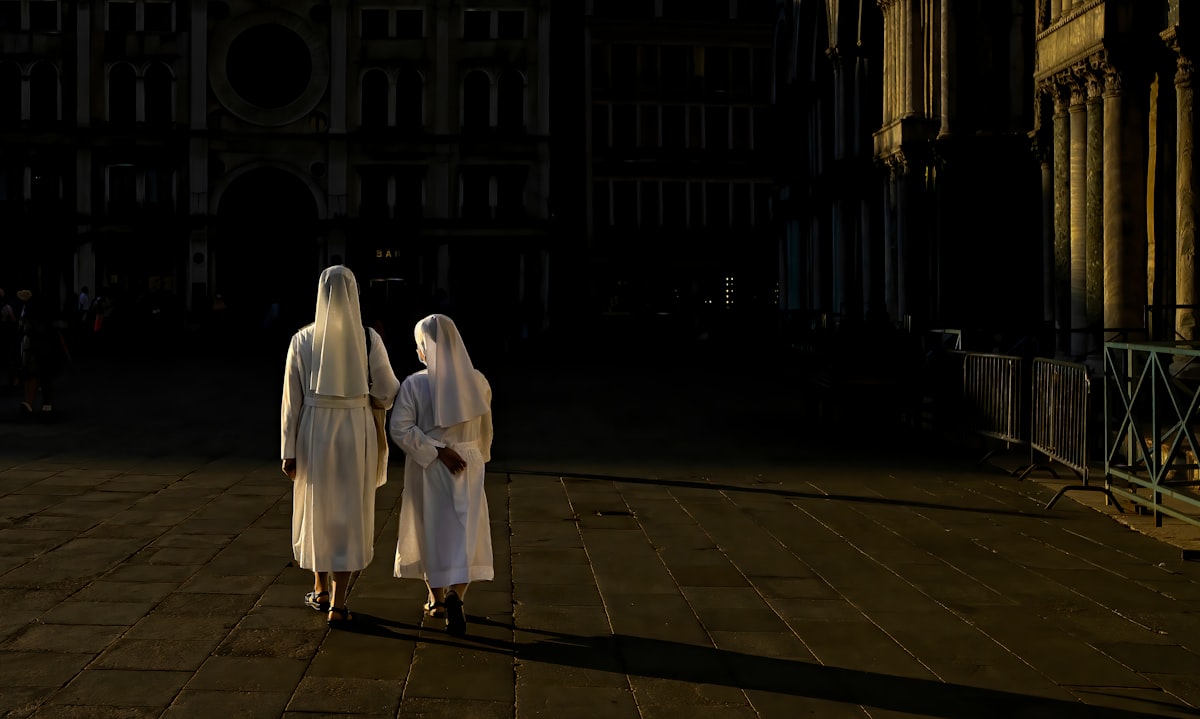
This is a list of my favorite 12 orders of Catholic nuns and sisters in no particular order. This list includes their history, and images of their habits. What is a Catholic Nun or Sister? In the Roman Catholic tradition, there are many religious institutes of nuns and sisters (the...
Learn the purpose of sdcason.com with this short blog.
Top selling books published by Shalone Cason.
This Lectionary was created ca. 1000 in Trier. Written in a clear Caroline minuscule, it contains decorated initials at the openings of important readings. A set of illuminated letters marks the beginning of the Epistle and Gospel lessons for Easter; they display the hierarchy of scripts with capital letters decorated...
This leaf once belonged to a small missal and was created in the late eleventh or early twelfth century. The distinct style of its miniature suggests it was made in Southern Germany, or possibly in the Tyrol region of Austria, where line drawing in colored inks had developed into a...
This Gospel Lectionary from the eleventh century was written in clear Carolingian minuscule in Regensburg, Germany. Its original treasure binding is very fragile because the spine is made from delicate Byzantine or Islamic silk, so it is not possible to photograph the whole manuscript. Only the cover has been photographed,...
This is a fragment from the upper arm of a hand-held bronze cross. One side contains a bust of Saint John the Baptist. The other side displays a cross-shaped monogram whose letters form the word KYPIE, vocative of "Lord" - probably the beginning of an inscription that...
* This painting refers to the biblical story, from the book of Numbers, in which Balaam, a prophet, foretells the coming of a powerful leader, or messiah, from the people of Israel. * The painting by Jean-Hippolyte Flandrin (1858) illustrates this prophetic moment, symbolizing hope and the rise of a new...
The biblical figure Daniel is known from the Old Testament for narratives such as Daniel in the lion's den and his wisdom under the Babylonian kings. Flandrin was a Neoclassical painter, meaning his works often feature calm, idealized representations and clear storytelling, especially with religious themes. Free DownloadThis...
Jean-Hippolyte Flandrin was a French painter famous for his portraits and religious works during the 19th century. The name Élisée refers to the biblical prophet Elisha (Élisée in French), who followed Elijah and was known for performing miracles in the Old Testament. Free DownloadThis image is in the public...
Samson was the last of the judges of the ancient Israelites mentioned in the Book of Judges (chapters 13 to 16) and one of the last leaders who "judged" the twelve tribes of Israel before the institution of the monarchy. Samson was a Nazirite, and he was given...
The Last Supper of Jesus and the Twelve Apostles has been a popular subject in Christian art, often featured in cycles depicting the Life of Christ. Depictions of the Last Supper in Christian art date back to early Christianity and can be seen in the Catacombs of Rome. The Last...
The account of Ruth and Boaz comes from the book of Ruth. Ruth was a poor widow staying with her Jewish mother-in-law. She met Boaz, a wealthy landowner, and impressed him with her loyalty and work ethic. He married Ruth, and their great-grandson would be King David....
This painting depicts the presentation of Christ in the temple (Luke 2:25-38). During Christ's Redemption of the Firstborn ceremony, Simon (a righteous man) and Anna (a prophetess) make prophecies about Christ, His future impact, and how He will redeem the world. Fugel's paintings tend...
In Ethiopian Orthodox art, the crucifixion is depicted with vibrant colors and stylized, flat forms that emphasize spiritual meaning and Christ’s divinity rather than his suffering. Christ is typically shown alive and serene, a symbol of victory over death, with figures such as Mary, John, and angels included to...
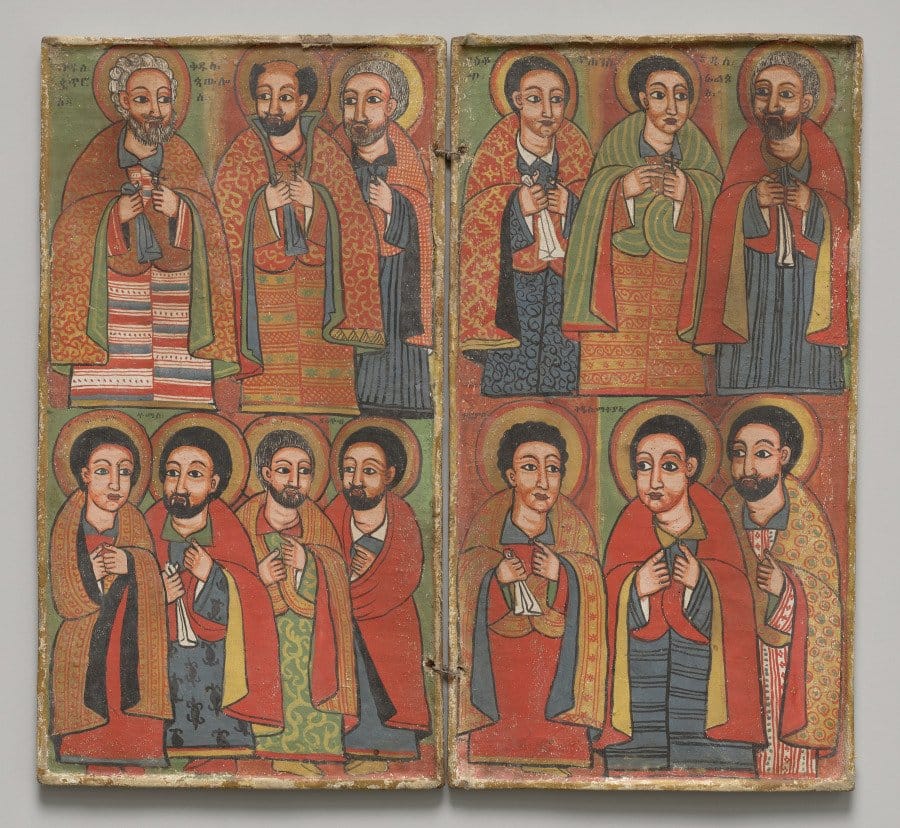
In Ethiopian Orthodox art, depictions of Christ and the Virgin Mary are characterized by vivid colors, stylized forms, and a deep sense of spiritual intimacy. Mary is often shown holding the Christ child or standing beside him, both figures with large, expressive eyes that reflect compassion, wisdom, and divine presence....
In Ethiopian Orthodox art, Saint George is a central and beloved figure, most famously depicted as a valiant knight on horseback slaying the dragon with a long spear. These images are highly stylized, featuring bold outlines, vivid colors, and flattened, frontal perspectives typical of Ethiopian iconography. Saint George is portrayed...
In Ethiopian Orthodox art, the Nativity scene is rendered with vivid, symbolic colors and stylized, flat figures that convey the spiritual significance of Christ’s birth. Mary is usually shown centrally positioned and often depicted reclining or seated with the Christ child nearby, both adorned with halos as symbols of...
In Ethiopian Orthodox art, archangels are depicted with strikingly vivid colors, elaborate garments, and an imposing sense of divine presence. They are often shown with large, expressive eyes and serene faces to signify their wisdom, vigilance, and purity. Archangels such as Michael and Gabriel are presented carrying specific symbols—Michael...
In Coptic Orthodox art, the crucifixion is depicted with a focus on spiritual symbolism and theological meaning rather than physical agony. Christ is shown on the cross with eyes open or gently closed, signifying awareness and acceptance, and often with a calm, compassionate expression. The style features vivid colors, frontal...
In Coptic Orthodox art, Saint Onophrios (also known as Onuphrius) is traditionally depicted as a wild, ascetic hermit, often portrayed with a long beard and covered in leaves or simple garments made from natural fibers. His appearance is intentionally rugged and unrefined to symbolize a life of radical asceticism, spiritual...
In Coptic Orthodox art, the meeting of Saint Anthony the Great and Saint Paul of Thebes is depicted with an emphasis on spiritual kinship, humility, and monastic virtue. The scene typically shows both saints clothed in simple monastic attire, often in a barren desert setting that symbolizes their withdrawal from...
In Coptic Orthodox art, Anthony the Great is often depicted as a dignified elder with a long beard, dressed in simple monastic robes and sometimes carrying a scroll or walking stick. His features are rendered in the stylized, frontal manner characteristic of Coptic iconography, with large, expressive eyes that reflect...
“The birds of the air and the lilies of the field” (1932) by Gebhard Fugel captures the artist’s ongoing engagement with biblical themes, rendered with clarity and contemplative devotion. Created during an era of great uncertainty in Germany, the painting draws inspiration from Christ’s teachings in the Sermon...
“The Burning Thorn Bush” (1932) by Gebhard Fugel emerges from a period of intense religious revival in early 20th-century Germany, where biblical scenes were often revisited to reaffirm spiritual values during times of cultural upheaval. Fugel—well known for his large-scale, immersive religious panoramas—applies his characteristic naturalism...
This panel represents Catherine Benincasa of Siena, one of the most influential women of the late Middle Ages. Affiliated with the Dominican order, she was renowned for her devotion to the poor and sick as well as for her mystical visions. In one such vision, she saw herself marked with...
The grief-stricken faces of the Virgin Mary and John the Evangelist once faced another panel referencing the Crucifixion. Their expressive features and weighty three dimensionality make their sorrow over Jesus’s death palpably human, while the golden space that they inhabit reinforces their sanctified status. Netherlandish devotional scenes sought...